
Investor Wisdom Shared Across Decades

I’ve known Joe Seta since we were both in our early 30s, working to build our fledgling direct marketing businesses. We were both very busy. We still are. In all those years (40+), we probably spent fewer than two dozen days together. But perhaps because our careers had similar arcs, we stayed in touch over email.

Joe is a regular reader of this blog. He’s also a serious student of health and investing, about which we share many views and opinions. Today’s main essay is one that he sent to me a few weeks ago. I wanted to publish it here because it addresses a common problem that investors face – a problem that can be very costly if you don’t know the facts.

Back in Rancho Santana 

I woke up at 5:30 this morning after seven hours of sleep. I was determined to get some writing done – real writing – but I failed. I got plenty of business work done, though, and a bit of blog writing. And I read (skim-read) two good books.
 
One was Mail and Get Rich by Ted Ciuba, a name I vaguely remember. (Given my memory, we may have been best friends. If so, apologies!) He published Mail and Get Rich in 2000 – 25 years ago. It has been sitting on one of my bookshelves in my home in Nicaragua since… could it have been since 2000? 
 
I’ve glanced at it dozens of times over the years, noting the title’s nod to Napoleon Hill’s 1937 classic Think and Grow Rich, but this was the first time I pulled it out to read. I expected it to be a nostalgic stroll down marketing memory lane and was surprised at how much of it was still relevant. Ciuba even talks about internet marketing, which was in its infancy in the 2000s. So I’m thinking that I should… I don’t know what. Maybe send him a thumbs-up? But after all these years, I don’t even know if he’s still alive. 
 
The other book was What We Talk About When We Talk About Raymond Carver, a series of interviews with Carver’s literary peers. I hadn’t realized it, but the literary world back then (the 1980s) had returned to the States and existed in the faculties of universities that had writing programs. The writers that were interviewed seemed to be as close and as passionate as the Lost Generation, and it made me sad. I couldn’t help thinking that, had I been more aware of what was going on, I might have been closer to it all. But I was just beginning my career as a businessman and a wealth builder and had abandoned, at least for the time being, my aspirations to become a serious writer. 
 
Tonight, I have to begin reading our Mules book club selection for Thursday – a book by that South African writer J.M. Coetzee, which I suspect I won’t like. We’ll see.
 

* * * * *

 
K and I had sunset drinks and a small dinner at the Club House. TG, my friend since fourth grade, who’s been living here for 20 years, joined us. The conversation was good until the two of them started talking about sports – professional basketball or football or whatever is going on right now. I know nothing about sports and am proud of it. Not only that, I get huffy when I have to listen to it being discussed. The worst is that K is completely fluent in virtually every sport known to man. I don’t know why, but I find it irritating.
 

* * * * *

 
K mentioned that R’s bill for various recent medical procedures was over a million dollars, but he paid only $300 out of pocket. This is clear proof that health insurance is a scam – a rigged system benefitting both the insurance industry and Big Medical. Something that could not happen in a truly competitive free market. 
 
Most people don’t get it because they can’t see the forest from the trees. They are happy to put some significant percentage of their earnings into health insurance and taxes that subsidize health costs because they fear what will happen to them if they are not “covered.”
 

* * * * *

 
We are looking forward to having the kids and grandkids here next week. I will try to get a good amount of work done before they get here, but, given the number of business meetings Gio has already scheduled for me, I’m not terribly optimistic about that.

Why I Trust the S&P 500 

By Joe Seta 

The primary reason so many stock investors underperform market averages is because they don’t understand a few basic facts about how stock trading works, and that allows them to allow their emotions to make the rules. Here is one of those facts: In order for an investment to work, there must be a Loser for there to be a Winner. It is a zero-sum game.

I debated this subject with ChatGPT for 2.5 hours this morning, and this was the outcome…

Question: “If you bought the S&P 500 at any record high since 1957, and the market dropped after that, how long did it actually take to get back to that level and make a new high?”

Answer: Using weekly data from 1957 to 2025, there were 232 times when the S&P 500 hit a new record, then dropped, then later climbed back up and passed that old record.

Here’s what the numbers say:
* Number of drops in market after record highs that fully recovered: 232
* Average time to get back to that old record: 3.28 months
* Middle (median) time to get back: 0.92 months (just under 1 month)

Now let’s break that down:
* Back to even in ≤ 1 month: 129 times
* Back to even in 1–3 months: 69 times
* Back to even in 3–6 months: 13 times
* Back to even in 6–12 months: 8 times
* Back to even in 13–18 months: 5 times
* Back to even in 19–24 months: 4 times
* Back to even in 25–36 months: 0 times
* Back to even in 37–48 months: 1 time
* Back to even in 49+ months: 3 times

Or in plain English:
* In 129 out of 232 cases (about 56% of the time), the S&P 500 got back to a new high in less than 1 month.
* In 198 out of 232 cases (about 85%), it got back to a new high within 3 months.
* About 91% of the time, it was back within 6 months.
* About 94% of the time, it was back within 1 year.
* About 98% of the time, it was back within 2 years.
* And in nearly 70 years, there were only 3 market drops that took longer than 4 years to fully recover.

Now add the big picture:

From 1957 through today, the S&P 500 has a perfect track record of eventually breaking its own record high after every drop.
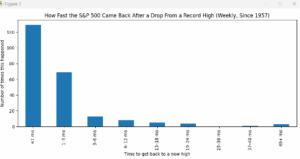
The market didn’t just “come back” — it went on to set new records again and again.

That doesn’t mean the future is guaranteed. But if you’re going to bet on anything, you’re betting that American business doesn’t permanently collapse. If we ever reached a point where the S&P 500 never recovered, we’d be living in a world where jobs, banks, and even the dollar were in serious trouble.

If you can’t live with that tiny but real possibility, you probably shouldn’t be in stocks at all.

When it comes to stock investing, I think in terms of two buckets:

* Bucket 1 – Money I might need soon (to live on).
This needs to be invested more safely, because even if most market drops recover within months, I can’t risk being stuck in one of those rare cases that takes several years.

* Bucket 2 – Money I won’t need for many years (or that will go to my kids and grandkids).
Here, I want to take advantage of the S&P 500’s comeback record. I’m not betting on what happens this week or this month – I’m betting on a system that, so far, has a 100% historical comeback record since 1957 and has always gone on to make new highs.

Yes, the market drops sometimes. It always has. If you look at the data, you will see that most of the time, it returns to new highs in months, not decades. In fact, in almost 70 years of history, the S&P 500 has never failed to get back to its high point and then go higher still.

That’s the kind of perspective that helps you stay calm when your screen is flashing red.

About Joe Seta

Joe Seta is a campaign builder and mentor who helps people make clear and confident choices. He designs outreach tools and systems that are easy to use and share, so others can create lasting impact. Joe cares deeply about child protection and advancement making complex ideas simple, especially for young people. His work blends storytelling with practical steps, giving collaborators the confidence to act without bias. He believes in ripple effects, small actions that spread outward to create big change.


It Is So Damn Easy to Feel Entitled 

It took me more than 30 years to learn it, but since I did (more than 30 years ago), I’ve been saying this to anyone that would listen: Of all human frailties, a sense of entitlement seems to be the easiest to acquire.

I think of the months it took my teenage self to acquire a taste for beer and the years as an adult it took me to become habituated to harder stuff. And I can verify, with a five-minute tour through Google, that the time it took me to become habituated to those petty vices wasn’t unusual.

The same was true for acquiring a taste for art and poetry when I was a child. And for acquiring an enjoyment of crossword puzzles, music, martial arts, films, etc. We are not born with attachments to most of the beliefs and preferences we end up having as adults. It takes time and exposure and sometimes training for them to find roots in our brains.

But not so much for the feeling of being entitled. As any parent with a toddler knows all too well, it develops early in childhood – even before the child can speak. And it sets in quite strongly, even and perhaps especially if there is no logical reason to support it.

I learned this in my 30s with my first significant gift of charity, an amount that was a significant percentage of my net worth at the time. Not only did the giftee come to believe that he/she was entitled to the start-up capital I provided for a business that was never going to benefit me personally, he/she accused me of being selfish and insensitive when I declined to invest more money in it later.

I learned it again and again as I developed Fun Limón, my family’s community center in Nicaragua. I’m retelling some of those stories in The Challenge of Charity, one of the books I’m working on, which compares the investments and rewards of building a for-profit resort on one side of the street and a non-profit institution on the other.

But perhaps the most surprising examples of this phenomenon are when help is provided to people that don’t deserve help but feel entitled to it, only to display their disappointment with it afterwards.

One of the stories I’d tell you if we were having this discussion in my cigar bar would be about a homeless (presumably) lady I passed by in LA every morning for a week. Her manner of asking for help was so fetching that I gave her a five-dollar bill every time on my way to have a coffee. She thanked me the first day, less enthusiastically the second day, and on the third day she spoke the words, but they didn’t feel like they were connected to her heart. On the fourth day, I got nothing but a nod – the kind you might expect from a bank teller helping you deposit your money into your account.

On the fifth day, I reached into my pocket to find no five-dollar bills. Only three singles. I gave her all three. She looked at the three dollar bills in her hand, crumpled them into a ball, and threw it in my face!

I was reminded of that when I saw this online last night.

Decca Aitkenhead’s Smartphone Experiment 

The Anxious Generation by Jonathan Haidt is one of the I-don’t-want-to-say-how-many book titles that are on my “read soon” list. I keep it on my list because Haidt blames smartphones for the dramatic increase in mental health problems in very young people, and I have grandchildren growing up in a world where children are given access to tablets and smartphones starting when they are toddlers.

Haidt’s theory is that the kids, themselves, feel tyrannized by their phones. And after reading his book, journalist Decca Aitkenhead decided to see what would happen if she forced her teenage sons and their friends to go on an unsupervised camping trip without their phones.

She wrote about the results of her experiment in this article for The Times.

Two Clips That Wow: Singing at the Piano & Mastering the Cue

Impressive: Tenor Steps Up to the Piano in Italian Restaurant 
I’m convinced that these videos are planned, not accidental. But they work. First, because it’s fun to watch the response of the crowd. Second, because sometimes, like in this clip, the performance is truly impressive.


Equally Impressive: When All You Have on the Table is “Gots” 
This one takes me back to my teens when I spent half of my weekends at the Rockville Center Cue Club, playing pool and sometimes in awe of the old guys who knew how to shoot. The shot in this clip is amazing for the “leave.” Do you know what I mean?

Embarrassing Math Moment

Oops! 

“In the Nov. 18 issue, you mentioned the government’s $37 trillion budget deficit. It is actually debt – and while you were in Japan, the number jumped to $38 trillion. The budget deficit in fiscal year 2025 will probably come in at $2 trillion.” – BS

My Response: Thank you! I want to think AI made the error, but I looked at my original draft and it was me. That’s embarrassing!