
What to Expect on the Way Up
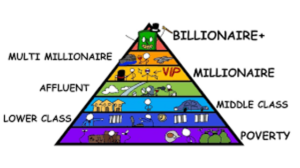
Just as there are stages one goes through in building a business, are there “stages” one goes through in building wealth? As we get richer, are there points at which we will encounter problems that could slow us down or even reverse our course and send us moving in the wrong direction?
And likewise, are there opportunities that come along on our journey that have the potential to accelerate our upward climb? Opportunities that can quickly and easily leapfrog us from one level of wealth to a higher one?
The answers aren’t obvious. And when I began to think about it, I had doubts. Maybe, I thought, the experience of growing richer is unique for everyone. Perhaps there is nothing universal about it – no common challenges and opportunities that can be identified and understood.
I thought back to my own journey – to the roadblocks that suddenly rose up before me and the forks in the road that made me wonder which path to take.
I remembered the painful moments when I allowed those roadblocks to halt my forward progress. I remembered the disappointment I felt, the self-doubt, and even the psychological battering I gave myself for ever thinking that I could one day become rich. I remembered, for example, feeling rich after I bought my first house, only to have my accountant explain to me that I had no wealth at all. What I had was a bank account with $5,000 in it and a $170,000 mortgage.
As time passed, those painful memories were joined by happier ones. I remembered the first year I earned $150,000, and the first year I earned a million dollars, and the first year I earned $10 million.
And something interesting happened. A pattern began to emerge. It became clear that wealth does not accumulate in a straight line. It grows in stages – five stages, to be exact.
Two Ways to Measure Wealth

The two most common ways to measure wealth are by income and net worth.
Income is an unreliable metric for defining wealth, since one can have a very high income and still be living from paycheck to paycheck and be deeply in debt. Nevertheless, for my purposes here, I’ve taken income into consideration because, in thinking about the challenges and opportunities I felt at various points along my own path from poverty to wealth, I recognized that many of them arose due to the level of my income, rather than the level of my net worth.
So, after much reflection and perhaps a bit too much research, this is what I’ve come up with…
The Five Stages of Wealth by income:
1. Less than $100,000
2. $100,000 to $350,000
3. $350,000 to $1 million
4. $1 million to $10 million
5. More than $10 million
The Five Stages of Wealth by net worth:
1. Zero to $100,000
2. $100,000 to $1 million
3. $1 million to $10 million
4. $10 million to $100 million
5. More than $100 million
Stage One: Income less than $100,000; Net worth zero to $100,000

Description: Life is tough. You are living paycheck to paycheck, barely scraping by. You have debt and no savings.
Problem: You are not making enough money to support yourself – and certainly not enough to support a spouse or children. You may lack the knowledge, skills, and credentials you need to get a higher paying job. You may feel stuck. And the people around you may assume that this is simply your lot in life.
Solution: You’ve got to start making a lot more money. Not eventually. Not next month or next week. You have to start right now.
Challenge: You need to reinvent yourself. You must make a serious commitment to not just make more money, but to become a non-stop money-making machine.
Game Plan: Get humble. Stop making excuses. Take responsibility for your current condition.
Stage Two: Income $100,000 to $350,000; Net worth $100,000 to $1 million

Description: You are (or should be) paying your bills and living modestly, but not saving.
Problem: You are working hard, but you are not making enough money to grow your wealth through investing. Because you are working so hard just to keep up with your financial obligations, you are feeling tapped out of the energy required to make a change.
Solution: You need to jack up your income – and not by 5% or 10%. You need to increase your income by 30% or more.
Challenge: You cannot safely do that, no matter how smart you think you are, through investing in stocks and bonds. Nor do you have the time and money to start a business that could, at least on paper, bring you more income.
Opportunity: You have only two possible ways to significantly increase your income by 30% or more: Find a job within the company you currently work for that will pay you 30%+ more than what you are making now. Or find a job with another company that will start you off with a salary that is 30%+ more than what you are making now.
Game Plan: You can pursue either option – or you can pursue both options simultaneously. If I were you, I would chart a course for myself to become a more valuable employee than I am now, with the intention of eventually being so valuable that my boss would be happy to give me a 30% raise. At the same time, I would research other companies in my industry, pick one that is growing quickly, and get a job with them.
Stage Three: Income $350,000 to $1 million; Net worth $1 million to $10 million

Description: You are (or should be) paying your bills, living well, and saving an increasing percentage of your net income.
Problem: With this level of income, you can live a rich life – so long as you spend your money wisely. The problem for many people that move into this income range is that they do not spend their money wisely. They attempt to upgrade the quality of their lives by increasing their spending even faster than the rate at which their income is increasing.
Solution: You have to train yourself to be financially disciplined. You can increase your spending, but only by a fraction of the amount that your income is increasing.
Challenge: You have to resist the urge to ratchet up your spending too much in an effort to ratchet up your enjoyment of your increased income.
Opportunity: By controlling your spending, you will have enough extra money to use to increase your wealth through investing.
Game Plan: When your income is $150,000 to 250,000, you should save at least 10% of what you have after taxes. When your income gets to between $500,000 and $1 million, you should aim at saving 20%.
Stage Four: Income $1 million to $10 million; Net worth $10 million to $100 million

Description: You are paying all your bills without thinking about it. You can buy a more expensive home, drive luxury cars, buy expensive toys, and take amazing vacations.
Problem: When you have an income this large, it is easy to lose any sense of financial discipline.
Solution: You have to realize that, at some point, spending a lot of money will do little to nothing to improve the quality of your life.
Challenge: You need to continuously remind yourself that spending money foolishly, even if you have plenty to spend, is not good. It does not make you feel better about yourself. Nor does it make your friends and loved ones admire you.
Opportunity: Once you are in the habit of spending money wisely, you will be amazed at how quickly your wealth increases. One opportunity at this level is the safety net you can build for yourself against future, unexpected financial damage. Another is the experience of being able to share your wealth.
Game Plan: Continue saving an increasingly large percentage of your net income as it rises. Move your goal up from 20% at $1 million to 25% at $2 million, 30% at $3 million, 40% at $4 million, and 50% at $5 million. At the same time, begin to experiment with donating some of your money to a cause or charity you believe in.
Stage Five: Income more than $10 million; Net worth more than $100 million

Description: You are among a very tiny percentage of income earners. In theory, you can afford to buy anything you want.
Problem: You can buy anything you want.
Solution: In making spending decisions, recognize that you will get much more pleasure and satisfaction from the money you share with others.
Challenge: Charity at a multimillion-dollar level is difficult and complicated. You have to learn how to give away your money wisely.
Opportunity: You must continue to find something meaningful to do with the money you don’t need (which is now most of your income).
Game Plan: Move slowly here, because it’s easy to do more harm than good with charitable donations.
The Main Lessons I Learned on the Way Up
Looking back on my own journey, what surprises me most is not how complicated building wealth was. It’s how predictable and solvable the problems at each stage turned out to be – and how rewarding the opportunities were.
