Then: The Housing Bubble

Now: The Car Debt Bubble?

According to a report published recently by YahooFinance, Americans are borrowing more money to buy cars than ever before. What’s worse, they are often borrowing more than the cars are worth.

Does that sound familiar?

This is what happened with housing in the years leading up to the 2008 crash.

It’s not unusual for drivers to carry some negative equity. But dealers say that an increasing number of people are showing up at their lots up to $10,000 underwater, or “upside-down,” on their trade-ins. They’re buying at still-sky-high prices and rolling debt from one car to another. “As trade-in values begin to cool, each month more and more consumers will find themselves falling from positive to negative equity,” said Ivan Drury, director of insights at auto-market researcher Edmunds. “Unless American car shoppers break their habit of buying again too soon, we’ll see the negative equity tide continue to rise.”

Another Reason Florida Rules 

I often remind my friends from New York that living there puts a significantly greater tax burden on them than living in Florida, where we have no income tax. In response, they say, “But you have higher property taxes.”

But that’s not true. As you can see from data compiled by WalletHub, Florida ranks 24th in terms of “effective real estate tax rate” (at 0.86%), whereas New York’s property taxes are more than twice as high at 1.73%.

Click here.
The Supply Chain Is Mostly Fixed

But Cost of Shipping Is Still High 

The supply chain, a major headache during the pandemic economy, is now in much better shape. According to Bloomberg:

“Containers that took up to 120 days to ship between warehouses in China and the US during the pandemic now take about 14 days, and the spot price for shipping a container from China to the US has declined from a peak of about $20k to about $1.2k, roughly equivalent to pre-pandemic prices.”

So why is the cost of shipping still so high?

For one thing, the costs of goods shipped to the US from Europe are still three times what they were before the pandemic. For another thing, shipping prices are usually determined by long-term contracts, so many importers are locked into rates set in 2021 and 2022.

Also…

* The cost of storage and truck and train shipping within the US is still high.

* Warehouse vacancy rates are low, pushing up rents.

* The logistics sector has struggled to hire and retain employees, which has led to higher salaries.

* The price of diesel fuel is twice what it was in the summer of 2020.

Is Inflation at 6.5% Good News?

After peaking at 9.0% in June of 2022, inflation today is down to 6.4%. That’s a considerable improvement. Will it begin to climb again? Or might it continue to go down?

My bet is that it will gradually move up in 2023 and 2024. Maybe into double-digit territory. (I’ll tell you why in a future issue.) But let’s assume that it stays the same. What does that mean in terms of future buying power?

According to the Rule of 72, an inflation rate of 6.4% will double prices in about 11 years. That would mean that just about everything that costs $100 now will cost $200 then. That may not sound so terrible… but think about it!

Sean’s 100% Guaranteed Market Predictions for 2023 

I’ve told you about Sean MacIntyre. He and his partner, Lindsey Hough, are running a personal finance business called DIY Wealth. It used to be called Creating Wealth, and I used to be its guru. Sean is the main man now, and that’s great for his subscribers. Because he’s very smart, but also honest, thoughtful, and funny!

Lindsey posted a video of Sean’s economic and investment predictions for 2023 last week. As you will see, he isn’t a big believer in prognosticating. But he does his best to explain some of the economic and financial fundamentals that are very likely to affect investments in 2023. If, like me, you are an amateur investor, you’ll find a lot here that will be edifying. One particularly interesting point that I intend to look into is about the proposed 15% minimum tax rate for corporations. If, as Sean says, this becomes a real thing, it could drastically depress earnings per share in 2023.

Check out the video here and let me know what you think. Is he right on or am I just a fanboy?

Inflation and the Rise of Monopolies

Bill Bonner predicted the inflation we are experiencing now many times over the past year or two. His prognostication was based on basic economics: He watched how the Fed was trying to engineer the supply and demand of dollars.

It all happened pretty much as it should have happened,” he said in the Jan. 10 issue of Bonner Private Research. And then he noted that the people that support government overspending, including the government and the mainstream media, are not accepting responsibility for their machinations. They are pointing fingers elsewhere.

“They aim to distract your attention from what is right before your eyes,” he wrote. “They claim ‘capitalism failed’ or ‘corporate greed’ suddenly imposed itself or, for those with no ax to grind, simply that there were ‘supply chain interruptions.’”

As an example, Bill quoted an article in The Guardian by Robert Reich, the former US Labor Secretary, making the case that corporate monopolies are to blame. Here’s an excerpt:

“Worried about sky-high airline fares and lousy service? That’s largely because airlines have merged from 12 carriers in 1980 to four today.

“Concerned about drug prices? A handful of drug companies control the pharmaceutical industry.

“Upset about food costs? Four giants now control over 80% of meat processing, 66% of the pork market, and 54% of the poultry market.

“Worried about grocery prices? Albertsons bought Safeway and now Kroger is buying Albertsons. Combined, they would control almost 22% of the grocery market in 167 cities across the country.

“And so on. The evidence of corporate concentration is everywhere.

“Put the responsibility where it belongs – on big corporations with power to raise their prices.”

You can read Bill’s entire essay here.

Gold and Silver: Should You Be a Buyer?

I bought a bunch of gold in 2002. Back then, it was selling for about $400 an ounce. Today, an ounce will cost you more than four times that much, as it’s trading at roughly $1,800. That’s a gross profit of about 8% a year. And even if you subtract from that the average inflation rate during those years (about 2.5%), you’d still be making about 6% a year or 350% over 20 years. (I did those calculations quickly in my head. They may be wrong. But not by much.)

A profit of more than 300% over a 20-year period is good, but it’s not going to make you rich. My approach to gold, though, was never to get rich from it, but to use it as (1) a hedge against inflation, and (2) insurance against financial Armageddon. As an inflation hedge, it has already exceeded my expectations. (You can read one of the many essays I wrote about buying gold here.)

If you don’t own gold now, or think you might want to, click here to watch a short, entertaining video by Sean MacIntyre (who has developed a huge international following by expanding on and in some cases revising my ideas about wealth building) on his reasons for buying precious metals right now.

And click here to check out his website, DIY Wealth.

More Data on the Next (Biggest?) Financial Crisis

I got into the business of publishing economic and investment advice in the early 1980s. Since then, I’ve witnessed four significant “crises.”

* The stock market crash of 1987

* The dot-com crash of 1995

* The real estate, banking, and liquidity crisis of 2007

* The COVID-19 government lockdown crisis of 2020 and 2021

Of these four, only the crash of 1987 surprised me. And the market bounced back relatively quickly, so I didn’t have a chance to learn anything from it. The dot-com crash seemed inevitable, given the crazy P/E ratios for dot-com stocks. The only question was: When? The real estate bubble was predictable in the same way. Prices were hyperinflated. They couldn’t possibly land. I was able to avoid getting hurt on that one by sticking to a simple, fundamental rule I use for investing in real estate. (I’ve written about it many times. Most recently, here.) The economic cost of the COVID lockdown was also easy to predict. But there was so much fear around it that nobody wanted to talk about it.

Recently, I’ve been feeling like we are about to go through another financial crisis. And this time, it won’t be short-lived, like the 1987 crash. Nor will it be restricted to segments of the market, like 1995 and 2007. This time, I’m betting it’s going to be across all investment classes and across the globe. And to make matters worse, it’s feeling like it’s going to be a long and debilitating period of stagflation.

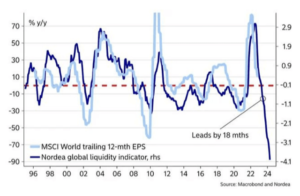
I hope I’m wrong. Here’s a chart I found last week (from Agora Confidential) that is worrying.

This chart offers insight into the amount of global capital sloshing around to purchase bonds and stocks. The Nordea global liquidity indicator – which signals a sharp contraction – typically leads the MSCI (corporate earnings) with a lag.

The MSCI signals that a slowdown is coming for corporate profits into 2023 and 2024. (Mainly as the impact of central bank rate hikes start to affect the global economy.)

If valuation comprehension was the story of 2022… looks like the story of 2023 will be earnings compression. Barring a dramatic pivot by the Federal Reserve, we can expect more volatility and lower stock prices in the year ahead.

Out of the Frying Pan… 

The Fed raised interest rates last week, the last cut of seven this year meant to curb 40-year-high inflation. The benchmark federal funds rates stood at near zero in March. With this last raise of 0.5%, it now stands at a 15-year high of 4.25% to 4.5%.

The federal fund rate affects borrowing costs for businesses and consumers – everything from credit cards to auto loans to mortgages. Raising the cost of borrowing typically slows the economy, reducing profits and driving up unemployment. Nobody likes inflation. But what voters really don’t like is an all-out recession.

It’s a tough problem for the Biden Administration, something they would very much like to get control of before the 2024 election. To bring down inflation, Powell must hang tough and continue to raise rates in 2023. But every tick up puts the economy that much closer to a serious recession.

Unemployment is rising. The GDP is slowing down. If that continues, the administration will do everything it can to pressure Powell into reversing course. But if he does, inflation will spike. Either way, the Republicans and Fox News will blame it on the Democrats.

It will be interesting to see how this plays out. And to figure out an investment strategy to respond to it.

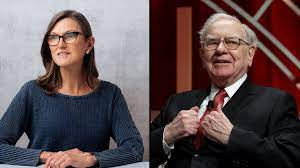
Cathie Woods vs. Warren Buffett 

Cathie Woods (of Ark Investing) is a crypto/disruptive technology investment superstar. She attracts the young, hip, and adventurous. The Hustle recently published a short article on her track record over the past five years compared to Wall Street’s favorite investor.

See who’s done better here.

Energy Supply and Demand Likely to Be a Big Topic This Winter 

That’s because of sanctions against Russia for the war on Ukraine, the unwillingness of OPEC to increase production, and the politically driven campaign to move too quickly away from fossil fuels towards green energy.

Some facts:

* NYC natural gas prices for January are 60% higher than they were last January.

* Consolidated Edison expects power bills to climb 22%.

* In France, the scarcity of oil and gas has spurred the government into reactivating nuclear power plants that had been scheduled to be retired – and even pressured them to increase production.

England faces an especially cold winter as the reduction of oil and gas from continental sources is compounded by an historic dip in wind activity. The reduction so far is equivalent to 16 gigawatts, or the amount of power that would be generated by 16 nuclear power plants.

Mark Rossano, an energy expert, made these points in a recent episode of “The Wiggin Sessions” podcast:

* Dispatchable power is dwindling, and it can drop off quickly due to the intermittent nature of renewables.

* The variability creates broad issues that only get amplified in the winter months as solar efficacy drops off considerably.

* Wind flows can adjust abruptly, and the remaining capacity (mainly fossil fuels) is stressed further.

* The harder you run these assets, the more wear and tear and maintenance that will be required to ensure their continuous use.

* The shift between baseload and peaking capacity is only getting worse as more coal is slated to come offline over the next six to 12 months.