
Is the American Dream still alive? Alex Green thinks it is, and I agree – mostly. Let me know what you think after reading his argument in today’s main essay.
Back Home and Reluctantly Catching Up on the News
I usually don’t get jet-lagged on return flights to the US – but since we returned from Japan last weekend, I’ve been waking up around 3:00 in the morning and have been unable to get back to sleep till about 5:00.
That’s given me some quiet time to catch up on some of the news I ignored while we were away – although I’m not sure that catching up was a good idea.
Before I touch on that, I want to say this: Flying back into Dulles Airport was a disappointing confirmation of my opinion of how much cleaner, safer, and generally more civilized Japan is than the US. The airport carpets were dirty. The escalators and elevators were grimy. The way people sort of muscle their way into lines to board flights seemed almost aggressive compared to Japanese travelers.
Still, it was good to be back home, in the land of the free and the brave.
What was the news I caught up on?
I skimmed the coverage of Mamdani’s win in the NYT, WSJ, NY Post, and a few online publications. None of the opinions I read were surprising. The Conservative publications worried about the economic damage this election will do to the city. The Liberal publications saw Mamdani’s victory as a confirmation that the future for the Democrats is further to the Left. The discussions that most interested me were about how effective Mamdani will be in getting his campaign promises realized.
If he succeeds, Conservative commentators said, the city will lose a large percentage of its tax base as billionaires transport themselves and, in some cases, even their businesses to sunnier climates, while Liberal commentators said that he will prove to the world that you can have a highly taxed and heavily restricted economy with all sorts of free services without going broke.
An argument I found particularly interesting went like this: The best possible outcome for Mamdani would be to have little success in getting his policies effected. There wouldn’t be a mass exodus of the city’s tax base, and – assuming crime and inflation didn’t get any worse – he’d have a decent chance of being reelected. That argument surprised me at first. But I’ve done a bit of research on NYC’s bureaucracy and past attempts to change it, and most of what I’ve read has convinced me that this outcome is more likely than any other, which would leave the city’s denizens with another four years of the same.
Another topic that was hot when I left for Japan – the government shutdown – was resolved at the 11th hour, with a handful of Democrats voting to open up shop again after failing to convince the voting public that the shutdown was the fault of the Republicans (even though they had voted to reopen the government more than a half-dozen times but were opposed by the Dems).
The good news, I suppose, is that I can stop worrying about what damage the shutdown would do and can get back to worrying about the bigger picture – i.e., our government’s $37 trillion budget deficit.
What else? Let me see…
It looks like retail stores are still being vandalized by gangs of young people in cities where stealing anything with a value below a thousand dollars had been reduced to a misdemeanor.
And the CDC is still recommending COVID shots – even for young children whose chances of dying from the biowarfare-invented virus has been zero and while evidence for the multitude of bad outcomes from the mRNA vaccines continues to mount.
Oh, well.
I’m happy to be back to our house across the street from the beach, smoking a Perdomo Robusto this evening with my favorite after-dinner drink (3/4 Cognac and 1/4 B&B), writing on my laptop and watching the sun go down.

Quoting the Dream: Voices on America’s Promise

“The American Dream is that dream of a land in which life should be better and richer and fuller for everyone, with opportunity for each according to ability or achievement.” – James Truslow Adams, American writer and historian

“The faith that anyone could move from rags to riches – with enough guts and gumption, hard work and nose to the grindstone – was once at the core of the American Dream.” – Robert Reich, former US Secretary of Labor

“The American dream is not that every man must be level with every other man. The American dream is that every man must be free to become whatever God intends he should become.” – Ronald Reagan
Is the American Dream Over?

According to a recent Gallup poll, a record-low 58% of US adults say they are “extremely” (41%) or “very” (17%) proud to be an American. That’s down from 90% in 2004. For Gen Zs, that number plummets to just 47%. And it’s not just a generational gap. Another poll concluded that 70% of US citizens believe the American Dream is no longer attainable.
“That isn’t just sad,” Alex Green says, “It’s a national tragedy.”
In his new book, The American Dream: Why It’s Still Alive… And How to Achieve It, which I had a chance to read just before it was published, Alex argues that all the pessimism about America’s future is largely unfounded and that the American Dream – the idea that the United States offers anyone and everyone a chance to acquire wealth and have a good life – is still very much a reality.
I’ve known Alex for more than 30 years. I met him in the early 1980s when he was working as an analyst for an international brokerage and accepted an invitation to speak at one of the investment conferences my partner and I were putting on at various overseas destinations. We became colleagues when, motivated to teach what he had learned about successful investing, he went to work as Chief Investment Strategist for the Oxford Club, an international research and advisory club created in 1983 to serve individual investors. Since then, we’ve become connected by a longstanding discussion about what I think of as the “soft side” of finance – how wealth is most efficiently created, and the dangers of seeking wealth without the right philosophical and ethical perspectives.
What Money Can Do
I’ve written a fair amount about the fact that having money does not automatically lead to happiness. However, that does not mean that acquiring wealth is not a worthy goal. As Alex explained in a recent email to me:
Money is independence. It liberates you from want, from work that is drudgery, from relationships that confine you. No one is truly free who is a slave to his job, his creditors, his circumstances, or his overhead.
Wealth is the great equalizer. If you have money, you have power – in the best sense. Wealth is freedom, security, and peace of mind.
It is not a guarantee of outcomes but of opportunity. It promises that everyone has the chance to improve their circumstances through their own efforts.
That last point is important. One of the things Alex and I have always agreed on is that the discussion about wealth and poverty that takes place in academia and in politics is too much about the geopolitics of wealth and the presumed power imbalance between the wealthy and the rest of the population. These perspectives can give comfort to those that are not wealthy, but the solutions they offer – geopolitical solutions – don’t work for the individual.
In other words, one cannot expect to improve one’s financial position in the world through state-level, political solutions. That has never worked and it never will. As Alex wrote in a recent essay, “Your power to change a nation of more than 330 million people is negligible. But your power to change yourself – your choices and your behavior – is limitless.”
That is just one of several key themes laid out in his new book.
The Pursuit of Wealth… and Happiness
The idea that every American can, without help from the government or family assistance, achieve a better, richer, and fuller life, is not new. Nor is it complicated. It is embedded in the wisdom of many of America’s greatest political, economic, and philosophical thinkers, from Thomas Jefferson to Benjamin Franklin to Milton Friedman to Steven Pinker.
Unlike societies built on rigid class structures or inherited privilege, America was founded on the radical notion that merit, effort, and character matter more than bloodline or social status.
The American Dream says, “Your future is not predetermined by your past. Your efforts matter. Your choices have consequences. You can be the author of your own story.”
The American Dream places the power of change squarely in the hands of the individual.
It encourages innovation, risk-taking, and resilience.
Belief in it turns setbacks into steppingstones and failures into learning experiences.
And that is why, as Alex says, the American Dream remains so important today. “It addresses the deepest human needs: the need for purpose, the hunger for progress, and the desire to build something lasting for future generations. In a world increasingly divided by cynicism and despair, the American Dream stands as a beacon of possibility. It has drawn millions to our shores and has guided millions more who were born here.”
It’s Our National Ethos… It Shapes Our Identity
In Alex’s view, the United States stands on three pillars:
* The Declaration of Independence, which declares that we are a free people whose rights preexist government
* The US Constitution, which both empowers and limits government to protect those rights
* The American Dream, which is how we exercise our right to pursue happiness
“Without these three pillars,” he says, “we are not the same nation. Not the same people. America is not perfect. It never has been. But it remains the best environment on Earth for ordinary people to build extraordinary lives.
“The souring of national sentiment isn’t driven by facts as much as by narratives.
“When every institution you trust – your school, the media, perhaps even your political party – emphasizes America’s sins over its successes, it’s easy to internalize the message that this country is fundamentally flawed – and the Dream is no longer real.”
Alex says that one of the chief objectives of The American Dream: Why It’s Still Alive… And How to Achieve It is to “better align perceptions with reality” – and he wrote the book for three kinds of readers:
* Disbelievers. They don’t believe the Dream is real because they don’t know what to do, aren’t doing it, or don’t realize they are already living it.
* Frustrated Dreamers. They know the Dream exists, but it feels out of reach.
* Dream Achievers. They’ve lived some version of the Dream, but they worry about their kids and grandkids. Or they want to help other Americans find the path.
“It’s natural to feel overwhelmed. If not outright depressed,” says Alex. “There’s an inertia – perhaps even a fear of failure – that keeps many from taking that first step.”
For those individuals, he has an interesting suggestion, which he explained in a recent essay he wrote introducing the book to the 160,000 Oxford Club members who rely on his wealth-building advice:
Become a star in your own reality show.
Nielsen Media Research tells us that Americans love reality shows where contestants are put in high-pressure situations and challenged to “win” using every bit of intelligence, cunning, and resourcefulness they can muster.
If you’re behind the eight ball financially, why not view your problems the same way?
I’ll bet if you were in front of a national television audience – and in danger of being voted off the show – you’d come up with some pretty good ideas, ones that might surprise the people around you.
(After all, you know better than anyone else the wasteful or frivolous spending that holds you back.)
Mihaly Csikszentmihalyi, author of Flow: The Psychology of Optimal Experience, thinks that’s a great idea. He asserts that the quickest way to increase your life satisfaction is to stop seeing your problems as difficulties and start viewing them as challenges to be accepted with a sense of playful enjoyment…
Facing your problems requires two things: a bit of imagination and a positive attitude. The payoff, in turn, can be huge. Whether you want to start your own business, get out of debt, or start down the path to financial freedom, you can begin by relishing the opportunity.
You might surprise yourself, too. Not only by achieving your goals, but by seeing how much satisfaction you get just moving toward them in a disciplined way….
Success – or the pursuit of it – validates your life. It gives you a reason to get out of bed in the morning. It also makes you feel good…. And that is why you should star in your own reality show. (One that, not coincidentally, actually deals with reality.) The obstacles in front of you will give you the opportunity to show the world – and yourself – what you’re made of. [And you will be rewarded by experiencing] one of life’s greatest pleasures: the feeling of earned success.
Those are some of the reasons I am recommending Alex’s new book. There are others. For example, he also covers issues that are top of the mind for many American investors, such as:
* Economic trends – e.g., that the percentage of US households earning more than $100K has increased significantly since 1980
* Why the US remains a land of opportunity due to a robust economy, leading global companies, and significant contributions to science and technology
* The life-enhancing value of embracing “Radical Responsibility”
* Why we are living in a new “Golden Age” for investors
* How to shorten the road to financial independence by embracing “The World’s Simplest Investment Portfolio”
As one reviewer recently put it, “The American Dream: Why It’s Still Alive… And How to Achieve It earns a well-deserved spot on the bookshelves of all ambitious individuals seeking long-term financial prosperity and to experience the ultimate feeling of earned success.”
Here’s a link to order the book.
About Alex Green

Alex Green was not a great student. He did not go to private schools. (“As a kid,” he says, “I didn’t even know anyone who attended a private school.) He did not study at an elite university. He did not earn any scholarships, academic honors, or advanced degrees. He had no family connections, no mentor, and no professional network. Yet he managed to become a multimillionaire while still a young man – and continues to compound his wealth today, as well as the wealth of the 160,000 Oxford Club members who follow his financial advice.
Why Is It That So Few People Get Rich?

Robert Frank, a columnist for The New York Times, has argued for some time that the key difference between the “haves” and the “have nots” in this country is not talent, hard work, and persistence but luck.
That sort of analysis sticks in my craw for two reasons: It is born from jealousy. It is absolutely not true.
It is true that many highly successful people, when asked for the secret to their success, cite luck as the reason. As I’ve said many times in previous essays, this is ingenuous. One need only read their autobiographies (or biographies written about them) or speak to anyone who has worked for them to know that it was a combination of personal strengths and disciplined habits.
They default to luck as an explanation for two reasons: Because it makes them seem modest and therefore likeable. And because when one looks back on a successful career, it often seems like it was a matter of luck.
In my case, it never seemed like luck. It seemed much more like decades of difficult challenges, frequent heart-crushing mistakes, and countless 12-hour days.
Alex Green (see today’s main essay, above), recently wrote about Dr. Bob Rotella, a leading sports psychologist whose views are diametrically opposed to Robert Frank’s, and summarized some of Rotella’s most important findings from his book How Champions Think:
No. 1: Intense Optimism – It’s tough to achieve great goals without an unwavering conviction that you will achieve them. Exceptional people generally do this through intense, purposeful visualization. Optimism keeps them juiced, excited about their prospects and willing to work harder than others. Optimism alone doesn’t guarantee anything, of course. But it is an essential ingredient. There is an almost perfect correlation between negative thinking and failure.
No. 2: A Confident Self-Image – We all construct a mental picture of ourselves. To a great extent, that self-image determines what we become in life. Champions view themselves as winners. And they devote their lives to making that image a reality.
No. 3: Habits of Excellence – Exceptional people follow strict habits that make success almost inevitable. Commitments are a dime a dozen. But unwavering perseverance is a virtue in short supply.
No. 4: An Unwavering Commitment to Process – Exceptional people don’t just pursue a dream. They fall in love with the process that makes it come true. They don’t just work longer and harder. They work smarter.
No. 5: Single-Mindedness – Champions don’t generally live well-rounded lives. They know they cannot be great business leaders, great parents, great athletes, great socializers, and tireless contributors to their communities. They have a passion for one thing and pursue it with the zeal of the newly converted.
No. 6: Honest Evaluation – Many people set high standards for themselves. But then they go easy on the self-evaluations. Average achievers tend to overestimate how hard they work. Champions don’t. They define excellence in specific terms and commit themselves to the most rigorous standards.
No. 7: Resilience – Failure is inevitable in business and in life. But exceptional people don’t let it define them. They find something to cling to, some hope for the future. Each setback comes with some lesson to be learned.
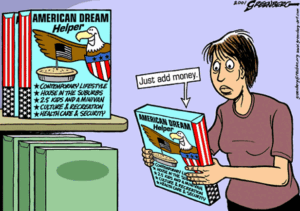
American Dream: Just Add Cash (and Hope)
The Entrepreneur’s Compass: Thanks to ‘Ready, Fire, Aim
“Thank you for Ready, Fire, Aim!”
“I wanted to personally thank you for writing Ready, Fire, Aim. It’s one of the few books that’s truly shaped how I think and operate as an entrepreneur. I’ve bought at least 10 copies over the years to share with friends and team members, and I reread it every quarter. It’s become something of a compass for me.
“Your ability to distill complex entrepreneurial stages into such actionable insight has had a lasting impact on my business and mindset. It’s rare to find a book that stays relevant at every stage of growth, but yours does exactly that.” – JC
Six Prompts, One Dare, Big Results
I Dare You!
Every day, I give myself six prompts to help me live my best life: Earn. Learn. Burn. Care. Share. Dare. This guy opted for “Dare.” See what happened.